9.30 am- 5.30 pm
08256 266624


On the occasion of Good Friday and Easter, we study the significance of the Cross (or Crucifix) in Christian theology. The cross is the figure and symbol of Christ Jesus, the Saviour of the World. (Didron 1886)
Jesus, the Son of God, was supernaturally conceived in a virgin named Mary, who was betrothed to Joseph. Being assured by God in a dream, Joseph married Mary and didn’t consummate the marriage until after the birth of Jesus in Bethlehem, Judea, in Israel, around 6 to 4 BCE. (Sauter 2025) The birth of Jesus is celebrated as Christmas.
Jesus grew up in Nazareth, Galilee, in northern Israel, and started his public ministry in Galilee at the age of 30, teaching and preaching about the kingdom of God to people from all walks of life. (Morris, The Gospel according to Matthew n.d.) He explained the Jewish Law to the people, offering a radical departure from traditional interpretation. This caused the religious leaders of that time to detest and fear him. He preached a message of repentance and forgiveness of sin and faith in God. He taught the people to love God with all their heart and to love their neighbour as they love themselves. He performed many miraculous signs, including the healing of the sick, delivering the demon-possessed and raising the dead to life. (Sanders 2026)
At the height of his popularity, the Jewish leaders of the time plotted to kill him. They persuaded the Roman leaders and the Jewish people to turn against him and kill him by crucifixion, an ancient Roman form of execution by nailing to a cross. Jesus was crucified and was buried. His death paid the price for the sins of the world, bringing redemption and salvation to mankind and reconciling us with God. Today, this is observed as Good Friday. (Morris, ‘Redemption’ Dictionary of Paul and his Letters 1993)
But by the glory of God, on the third day, Jesus was resurrected to life and appeared to his disciples in a renewed body! He proclaimed life to all those who believe in him. His victory over death, sin and the powers of evil is celebrated on Easter Sunday (or Resurrection Day). (Sanders 2026)
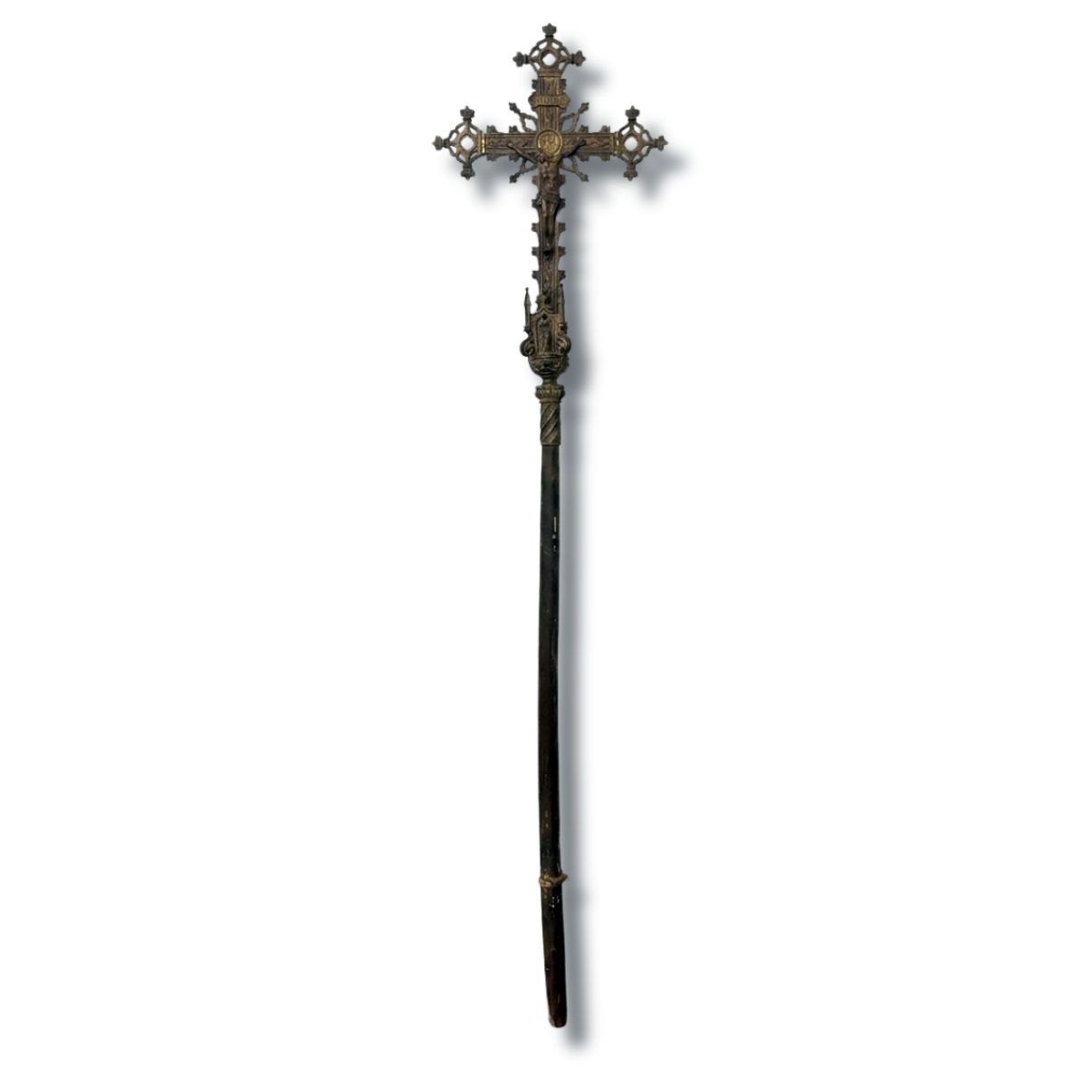
The processional cross is a crucifix that is carried in Christian processions. A crucifix is a cross with an image of Jesus on it, as distinct from a bare cross. The crucifix emphasises Jesus’ sacrifice, his death by crucifixion. The crucifix is a principal symbol for many groups of Christians, especially in the Catholic, Lutheran and Anglican Church. (Herbermann 1913)
The processional cross is made of 3 parts – the cross, the base and the staff. The cross consists of an upright post or stipes and a crosspiece to which the sufferer’s arms are nailed. There is a short projecting nameplate, with the letters INRI (“King of the Jews”, a title used for Jesus). The base is a three-sided piece, with each side bearing the figure of Mother Mary, with folded hands, in prayer. The intricate, pointed ornamentation of the cross and the base is in the Gothic Revival style of the 16th and 17th centuries. The staff is made of wood. The cross is attached to the top of the staff with a bracket. The three parts together reach a height of 7.4 ft. (Processional Cross n.d.)
Didron, Adolphe Napoleon. 1886. The History of Christian Art in the Middle Ages. London: William Clowels and Sons, Ltd.
Herbermann, Charles. 1913. “Processional Cross.” In Catholic Encyclopedia. New York: Robert Appleton Company.
Morris, Leon. 1993. ‘Redemption’ Dictionary of Paul and his Letters. InterVarsity Press.
Morris, Leon. n.d. “The Gospel according to Matthew.” ISBN 0-85111-338-9 71.
n.d. Processional Cross. https://collections.vam.ac.uk/item/O105617/processional-cross-aw-pugin/.
Sanders. 2026. “Jesus.” In Encyclopedia Britannica, by Pelikan, J.J. E. https://www.britannica.com/biography/Jesus.
Sauter, Megan. 2025. “When Was Jesus Born—B.C. or A.D.?” Biblical archaeology. 27 December. https://www.biblicalarchaeology.org/daily/people-cultures-in-the-bible/jesus-historical-jesus/when-was-jesus-born-bc-or-ad/.